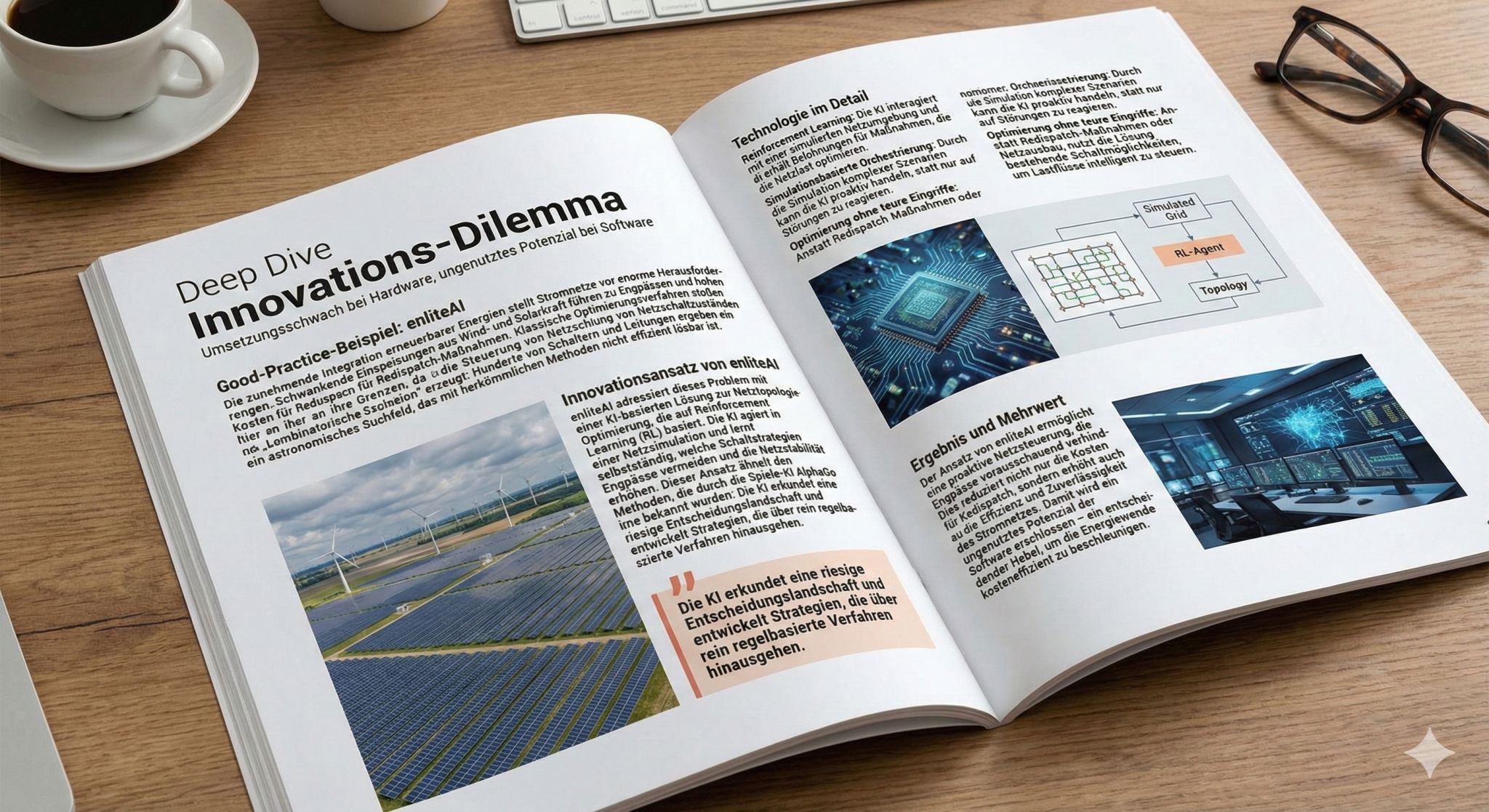
On 14 August 2026 the Austrian business magazine trend published a feature by Paula-Marie Pucker on what summer heat does to power grids — and how artificial intelligence can identify bottlenecks before they become outages. Our CEO Clemens Wasner was one of the experts interviewed.
Hot weather pushes grids from two sides at once: cooling demand rises while the thermal capacity of lines and transformers falls. In a distribution grid that is already absorbing record volumes of solar feed-in, the margin between normal operation and a local overload gets thin — and operators need to see it coming hours ahead, not minutes.
Clemens explained that the strength of AI in this setting is scale: it can analyse very large volumes of weather, consumption, generation and grid data at the same time, and turn them into an early warning and a set of options for the control room. In the article he points to the potential to reduce investment costs by up to 30 percent in specific applications — by using the capacity a grid already has before reinforcing it.
We asked trend to print a distinction we care about: our first-place result in the 2022 Learning to Run a Power Network competition — a 60 percent reduction in required redispatch — was achieved on realistic network models, not on a real distribution grid. Real-grid numbers come from real-grid projects, and we only publish them once they have been measured.
The article also covers our current proof of concept on an Austrian distribution grid, run with real network and smart-meter data, and our collaboration with Beyond Tech — the joint venture of Burgenland Energie and CEYOND — which provides the data architecture and integration layer.
The full article (in German) is available on trend.at via the link below.