
FLEX by EnliteAI Energy

Unlock more capacity from the grid you already have.

FLEX turns existing grid data into secure, explainable operating decisions — helping TSOs and DSOs connect renewables faster, relieve congestion and defer avoidable reinforcement. The operator always decides.

Less copper. More code.
FLEX — congestion assistant
live
Constraint detected
Line L-214 approaching thermal limit
Ranked recommendations
1
Switch line L-214 to busbar B at substation S-12
Non-costly switching · N-1 secure ✓
2
Reconfigure busbar coupler at substation S-7
Non-costly switching · N-1 secure ✓
3
Activate contracted flexibility: battery cluster K
Contracted flexibility · N-1 secure ✓
The operator decides.
Review options
01
Grid constraint
02
AI analyses options
03
Ranked recommendation
04
Operator decides
Why now

Connections, congestion, CAPEX — and new statutory duties

Connection requests outpace reinforcement across Europe, and EU market-design rules point one way: flexible connections, published capacity, faster answers. In Austria, the ElWG turns that direction into concrete requirements and timelines — in force since December 2025.
Flexible network access
Temporary route: full access due 12–24 months after contract conclusion, by network level
→ Dynamic Operating Envelopes
Capacity publication & network development plans
Ongoing — NEP duty now from 1,000 metering points
→ Hosting Capacity
Peak capping under § 101
PV in force (export limit not below 70% of module peak); wind from 1 January 2027
→ Flexible Asset Management
Your duties in detail — Austria, Germany, Italy →
What FLEX solves — and with what

From operator problem to FLEX module

All use cases in detail →
Measured, not modelled

Measured results from real grids

−18.1 pp

Lower peak line loading — from 60.2% to 42.1% on a real Austrian distribution grid, measured with Stadtwerke Kapfenberg.

< 5 min

Day-ahead topology plans in under five minutes on real TenneT grid data (1,659 substations) — every in-distribution day solved N-1-secure in joint research, ahead of expert baselines.

99.99%

Of operational voltage violations mitigated on an Italian DSO grid (ENEL, 15-minute data), computed ~5,000× faster than the baseline approach.

The research behind these numbers →
How it works

Digital twin, reinforcement learning, human oversight

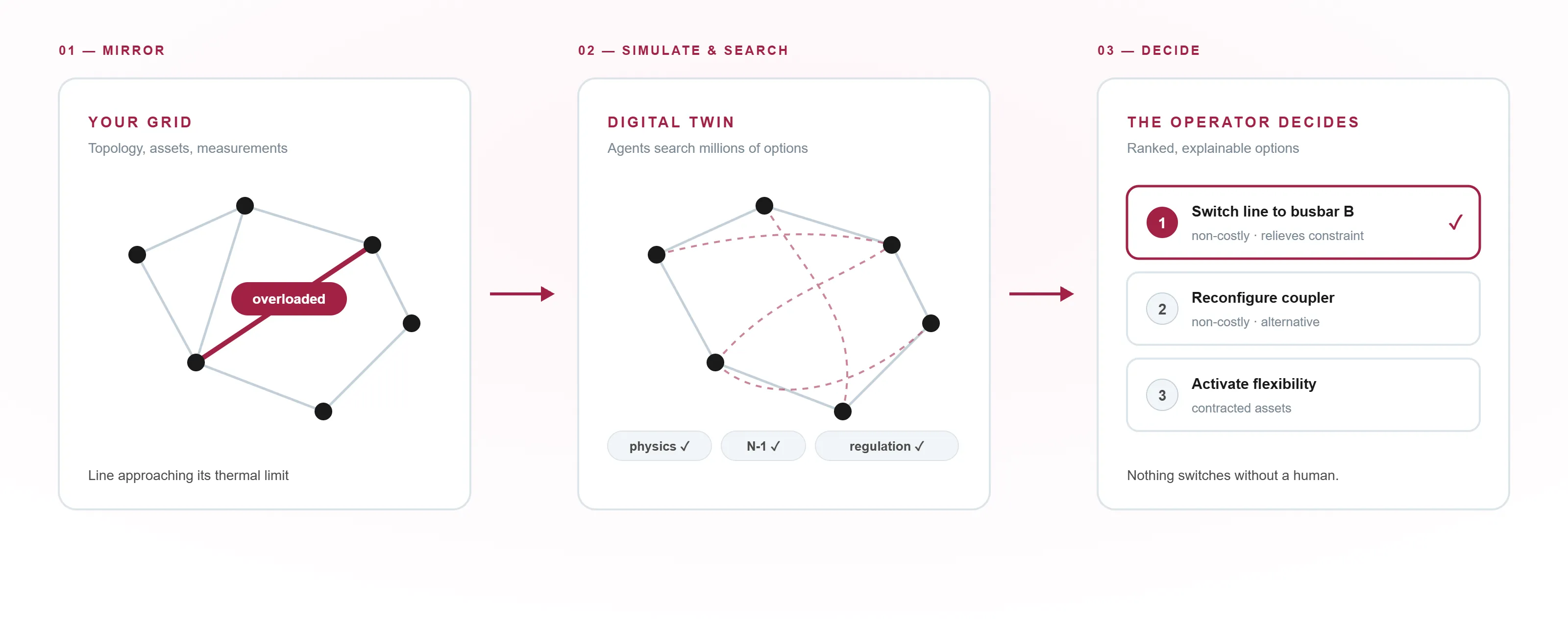
How FLEX works: your grid is mirrored in a digital twin, agents search millions of options against physics and regulation, and the operator decides between ranked recommendations.
1
A digital twin of your grid

We mirror your network — topology, assets, measurements — in a physics-accurate simulation built on open formats: CIM/CGMES, pandapower, OpenDSS, PSS/E.

2
Agents search the action space

Reinforcement-learning agents explore millions of switching and dispatch sequences against the twin — with physics and regulatory constraints in the loop — and surface the few that safely relieve the constraint.

3
The operator decides

Ranked, explainable recommendations land with your control room and planning teams. Nothing switches without a human.

The technology in depth →
In the media
trend
ORF
PwC
Forbes
Handelsblatt
All coverage →
Built for real grids
Measured on real networks — not only on benchmarks.
FLEX results come from real Austrian distribution grids and joint research with European transmission operators.
The research and measurements behind FLEX →
Who we work with

Our customers and research partners

Customer engagements
Wiener Netze GmbH
Netz Burgenland GmbH
TenneT TSO B.V.
Research collaborations
Stadtwerke Kapfenberg GmbH
Stadtwerke Mürzzuschlag GmbH
Netz Niederösterreich GmbH
Energienetze Steiermark GmbH
RTE
Enel
Customers & projects in detail →

Validate FLEX on your own grid data

Fixed scope, defined data requirements, measured results — and a business case you can take to your board.